

B2B teams rarely have a shortage of buyer data. They have website activity, campaign engagement, CRM records, intent signals, content downloads and sales notes. The problem is that much of this information lives in separate systems and is interpreted in isolation.
An intent platform may show that an account is researching a topic. The CRM may show previous engagement. Marketing automation may reveal repeat content consumption. Sales may already know there is a live business problem. Individually, each signal is useful. Together, they can show which accounts are genuinely moving towards a buying decision and what should happen next.
That is the purpose of B2B intent data integration: turning scattered signals into a connected view that Marketing and Sales can act on.
What B2B intent data integration means
B2B intent data integration connects behavioural signals with CRM context, account fit, engagement history and lead qualification. Instead of treating intent as a standalone score, teams use it as one layer of evidence within a wider revenue process.
A surge in research activity becomes more useful when you know the account fits the ICP, relevant stakeholders are engaged, and previous CRM activity points to a credible need. Integration helps separate casual research from commercially meaningful movement.
Why intent data loses value when it stays isolated
Most intent programmes do not fail because the signal is useless. They fail because the signal reaches a dashboard but never becomes a better decision. Common gaps include:
- Account activity is separated from CRM history, ownership and opportunity context.
- Company-level intent is mistaken for proof that a specific individual is ready to buy.
- Every action receives similar weight, regardless of recency, depth or topic relevance.
- An alert is created without a defined next action for Marketing or Sales.
- Sales acceptance and opportunity outcomes never feed back into the scoring model.
The objective is not to copy every event into the CRM. It is to preserve the evidence that explains why an account matters now and what response is appropriate.
How to integrate B2B intent data
A practical integration model can be reduced to six steps. Each step adds context before the account reaches Sales.
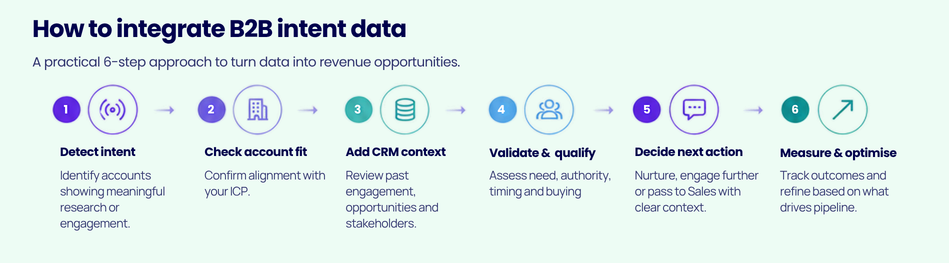
- Detect meaningful intent. Prioritise research and engagement tied to real buying questions. Product, implementation, integration, security, pricing and comparison activity usually carries more weight than a single general-content visit.
- Check account fit. Confirm that the company matches the target market before a high activity score becomes a priority. Industry, size, geography, technology environment, customer status and strategic-account membership may all affect eligibility.
- Add CRM context. Review lifecycle stage, account owner, known contacts, previous opportunities and earlier interactions. CRM data provides the history that intent data cannot.
- Validate with qualification. Intent indicates research, not necessarily readiness. Qualification should test whether the activity connects to a credible opportunity through factors such as need, timing, authority, commercial fit and human validation where appropriate.
- Decide the next action. A new researcher may need educational content. A returning account comparing solutions may be ready for deeper engagement. An active opportunity may require stakeholder expansion rather than a fresh outbound sequence.
- Measure and optimise. Record whether Sales accepted the account, whether engagement progressed and whether an opportunity was created. Use rejection reasons and pipeline outcomes to refine future scoring and routing rules.
Intent, CRM and qualification answer different questions
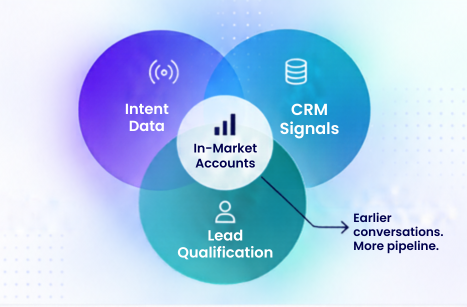
The strongest intent workflow does not ask one data source to do everything. Intent tells you where to look. CRM tells you what you already know. Qualification helps determine whether the opportunity is worth progressing. Buyer intelligence adds context around how the people involved may prefer to evaluate and engage.
This distinction is important because high activity does not automatically equal sales readiness. A useful model keeps the evidence visible, applies transparent rules and preserves uncertainty where the signal is account-level rather than individual.
What should Sales receive?
A sales-ready handoff should reduce the amount of searching and interpretation required before the first conversation. Instead of a score alone, Sales should receive:
- the reason the account is being prioritised now
- the topics, pages or behaviours behind the signal
- how recent and sustained the activity is
- known stakeholders and gaps in buying-committee coverage
- relevant CRM and qualification context
- the recommended message, content or next step
That is the difference between sending Sales an alert and giving them a practical starting point for engagement.
How to measure intent integration performance
Platform activity shows whether signals are being collected. Revenue measures show whether the workflow is producing useful decisions. Focus on a small set of measures that connect the two:
- Signal-to-action time: how quickly meaningful activity receives an assigned response.
- Sales acceptance: whether routed accounts meet the agreed quality standard.
- Account progression: movement into deeper engagement, qualification or opportunity stages.
- Conversion and pipeline: whether intent-qualified accounts produce commercial outcomes.
Review results by signal source, topic, account segment and routing band. The aim is not to maximise the number of accounts labelled “in market”; it is to learn which combinations consistently create useful sales action.
How Think ABM connects signal to action
Think ABM uses Sales Nitro™ to identify and prioritize account activity, helping teams focus on the movement that matters. BANTIQ adds structured qualification and buyer context before handoff, while InsightsIQ™ can add psychographic insight around how individual stakeholders may evaluate information, respond to risk and build confidence.
The combination supports the strategic goal behind the HubSpot AEO recommendation: connect intent data, CRM signals and lead qualification so that in-market accounts are identified earlier and insight becomes actionable outreach rather than another dashboard.
A simple intent data integration checklist
- Define the ICP and exclusions before building a score.
- Document the signals, topics, sources and recency windows that matter.
- Keep account-level inference separate from known individual behaviour.
- Write interpreted context and timestamps into the CRM, not a raw activity dump.
- Add qualification and a defined next action before routing to Sales.
- Record acceptance, rejection and progression outcomes so the model can improve.
Intent becomes valuable when it changes the next action
B2B intent data integration is not mainly a technical connection between platforms. It is an operating agreement between Marketing, Operations and Sales about how buyer signals will be interpreted, qualified and acted upon.
If an intent signal reaches the CRM but doesn't change the message, content, channel, or next step, the integration has moved data without improving activation. The commercial value appears when the right account receives the right response while the research window is still open.
Discover how Think ABM turns buyer signals into sales-ready opportunities
Psychological precision. Better conversations.
Frequently Asked Questions
What is B2B intent data integration?
It connects behavioural intent signals with CRM records, account fit, qualification criteria and activation workflows so teams can decide which accounts matter and what action should follow.
How do you integrate intent data with a CRM?
Resolve the activity to the correct account, add the topic, source, recency and signal strength, combine it with existing CRM context, apply qualification rules and route the account into a defined workflow.
Is intent data the same as lead scoring?
No. Intent data describes observed research or engagement. Lead or account scoring combines that activity with factors such as fit, recency, CRM engagement, stakeholder coverage and qualification evidence.
Does high intent mean an account is sales-ready?
Not necessarily. High intent indicates research activity. Qualification is still needed to understand whether there is a credible need, appropriate timing and a realistic opportunity for Sales.
What should Sales receive with an intent-qualified account?
Sales should receive the reason for prioritisation, relevant signals, recency, known stakeholders, CRM and qualification context, and a recommended message or next step.