

B2B marketers have access to more buyer intelligence than ever.
Intent platforms can show which accounts are researching a category. Engagement data reveals which content prospects are consuming. Buying committee analysis helps identify who is involved in the decision, while psychographic intelligence can provide clues about how different stakeholders prefer to evaluate information.
Yet despite all this, the outreach often looks remarkably familiar.
A high-intent CIO still receives the standard nurture email. A risk-conscious buyer gets the same innovation-led message as an early adopter. Someone researching implementation challenges is immediately pushed towards a demo. And every member of a buying committee receives the same asset because they happen to work at the same account.
The problem is no longer simply that organisations lack buyer data.
The problem is that the intelligence they collect doesn't always change what Marketing or Sales does next.
That is the Buyer Activation Gap.
Buyer Intelligence only matters when it changes the next action
Buyer Intelligence can help revenue teams build a much clearer picture of an opportunity. Intent intelligence can reveal what buyers are researching. Psychographic intelligence can add context around how an individual may evaluate a decision. Buying committee intelligence can help explain who is involved and what different stakeholders care about.
But knowing more does not automatically improve engagement.
The commercial value appears when that intelligence changes the next action: the message, content, channel, CTA or sales conversation.
If a team learns that a buyer is highly risk-conscious but keeps sending the same generic campaign, the insight adds information without improving relevance.
The objective should therefore be to turn Buyer Intelligence into Buyer Activation.
The same intent signal can require a different response
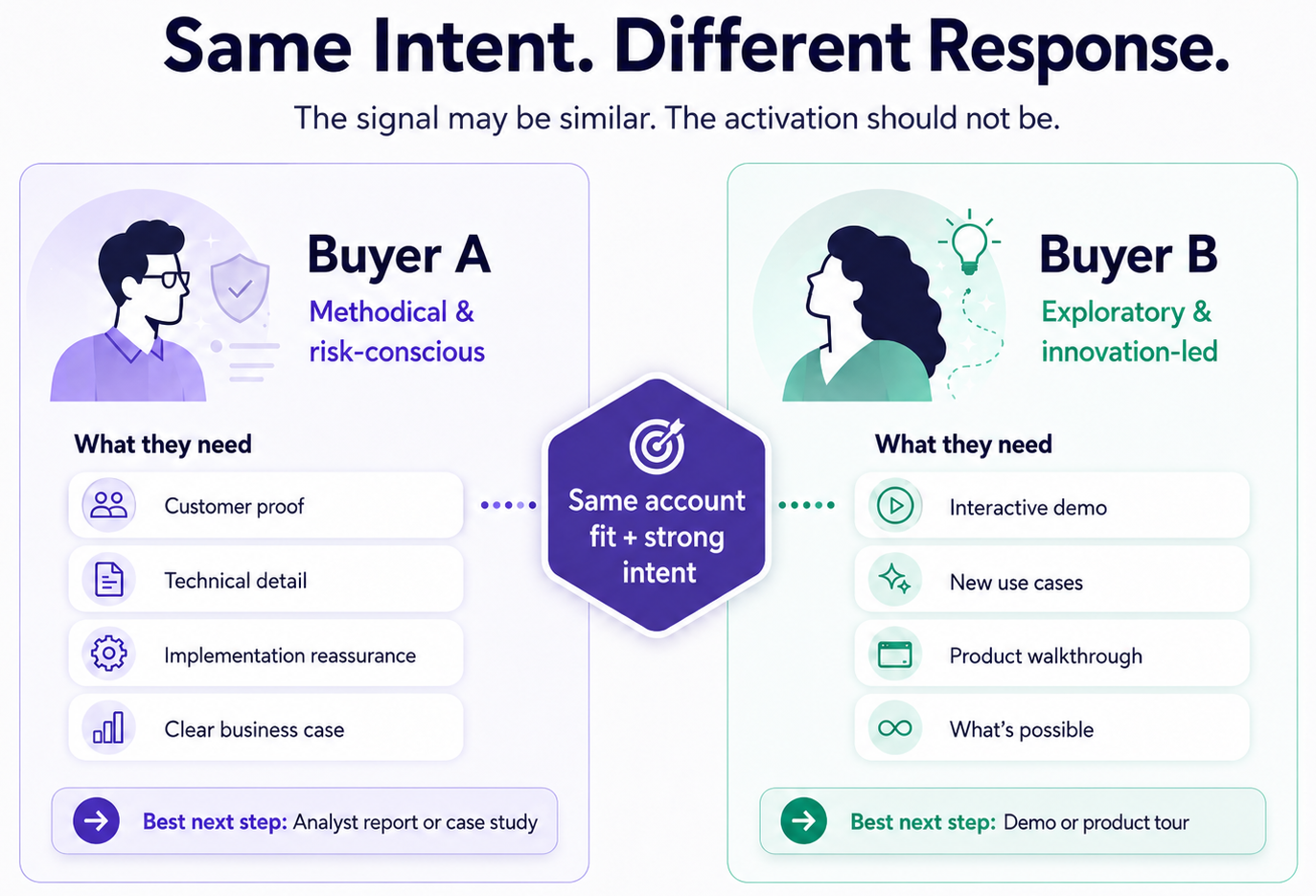
Consider two senior technology buyers researching the same enterprise platform.
Both have strong intent. Both work for accounts that match the ICP. Both are senior enough to influence the purchase.
On a dashboard, they may look almost identical.
But one buyer is methodical and risk-conscious. They may want customer proof, technical detail, implementation reassurance and a clear commercial case before engaging further.
The other is more exploratory and innovation-led. They may respond better to interactive demonstrations, new use cases, product exploration and examples of what is possible.
The product has not changed. The account may not have changed. Even the intent signal may look similar.
What needs to change is the activation.
This is where organisations either turn intelligence into advantage or fall back into generic marketing.
Where the Buyer Activation Gap usually appears
The gap usually shows up in four areas.
Content
Most B2B teams organise content around funnel stages: awareness, consideration and decision.
That is useful, but two buyers at the same stage can still need very different information.
A cautious evaluator may want an analyst report or customer case study. A hands-on buyer may prefer a demonstration. A technical stakeholder may need an implementation guide, while a commercial decision-maker wants a business case.
The question should not only be, “Which asset belongs at this stage?”
It should also be, “Which asset will help this buyer make the next decision?”
Messaging
Personalisation often stops at company name, industry or job title.
That can make a message look personalised without making it particularly persuasive.
Buyer activation goes one level deeper.
An innovation-led stakeholder may respond to competitive advantage and future possibilities. A risk-conscious buyer may need reassurance and evidence. A commercially focused stakeholder may care more about efficiency, value and measurable outcomes.
The goal is not to create a completely different campaign for every person.
It is to change the emphasis of the conversation.
Calls to action
This is one of the easiest places to see whether intelligence is actually being used.
Too many campaigns still default to one CTA:
Book a demo.
But a buyer who has only just entered the research phase may not be ready for that.
Depending on their context, a more relevant next step might be:
- See how it works
- Compare approaches
- View the architecture
- Explore customer results
- Build the business case
- Talk to an expert
Good activation doesn’t just personalise the message. It personalises what you ask the buyer to do next.
Sales follow-up
This may be the most important gap of all.
Marketing can collect intent data, engagement history, content interactions, qualification details and psychographic insight, only for Sales to receive a CRM record containing a name, company, title and phone number.
Most of the useful context disappears at the point where it could have the greatest value.
- Why may the buyer be engaging now?
- What have they already shown interest in?
- Which priorities are likely to matter?
- How should the first conversation be approached?
- What content might be relevant next?
A better lead is not simply one with more fields attached. It is one that helps create a better conversation.
A simple Buyer Activation loop
A useful way to think about the process is:
Signal → Interpretation → Decision → Activation → Feedback
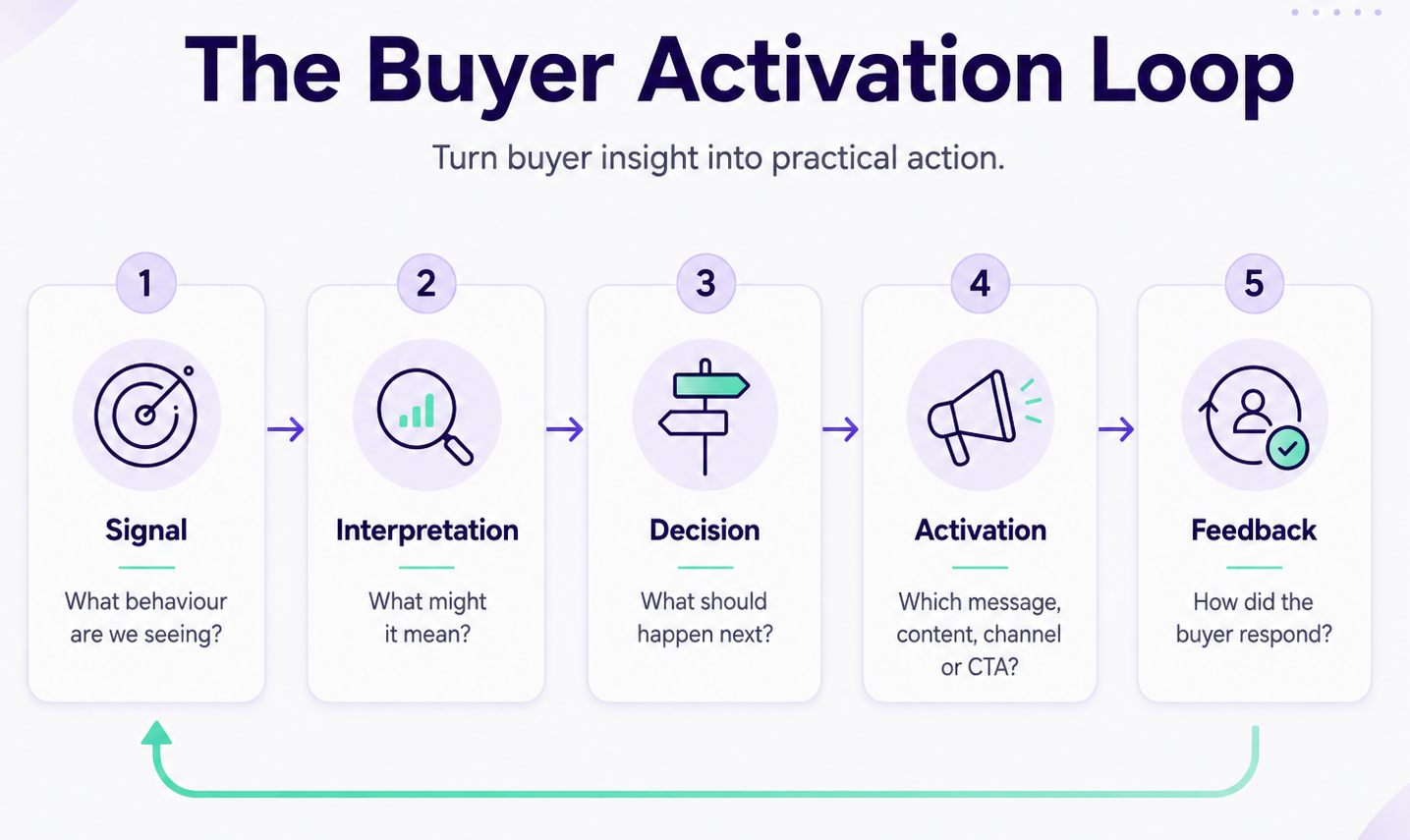
- Signal: What behaviour are we seeing?
- Interpretation: What might that behaviour mean, and who appears to be involved?
- Decision: What should happen next; nurture, sales engagement, stakeholder expansion or further qualification?
- Activation: Which message, content, channel and CTA should be used?
- Feedback: How did the buyer respond, and what does that tell us about the next action?
The important part is the loop.
Every response creates more intelligence, which should improve the next interaction.
This is how Buyer Intelligence becomes operational, not just another reporting layer.
Closing the Buyer Activation Gap
Closing the gap does not require rebuilding the entire marketing stack. It requires connecting buyer insight to everyday decisions.
Whenever a meaningful signal appears, ask:
- What do we understand now that we did not know before?
- Does that change who we should engage?
- Does it change what we should say or show them?
- Does it change what we should ask them to do next?
If nothing changes, the intelligence has probably not been activated.
At Think ABM, Sales Nitro™ helps identify and prioritise buying activity, while InsightsIQ™ adds psychographic context around how individual buyers are likely to evaluate and engage. Human validation adds another layer before that intelligence reaches revenue teams.
But the objective is not simply to know more about buyers.
It is to make that knowledge useful.
Because competitive advantage doesn't come from having more signals than everyone else.
It comes from knowing what to do with them.
Psychological Precision. Better Conversations.
Frequently Asked Questions
What is the Buyer Activation Gap?
The Buyer Activation Gap is the disconnect between having useful buyer intelligence and actually changing the next marketing or sales action because of it. It appears when teams collect intent, engagement, psychographic or buying committee data but still use generic messaging, content or follow-up.
How is Buyer Activation different from Buyer Intelligence?
Buyer Intelligence explains what buyers are doing, who is involved and how they are likely to evaluate a decision. Buyer Activation is the next step: using that intelligence to choose the right message, content, channel, CTA or sales approach.
Why do high-intent buyers still ignore outreach?
High intent does not automatically mean the message is relevant. Two buyers can show similar intent while having very different priorities, risk tolerance and decision styles. If outreach does not reflect that context, strong signals can still produce weak engagement.
How can B2B marketers close the Buyer Activation Gap?
Connect every meaningful buyer insight to a practical decision. Ask whether the insight should change who you engage, what you say, what content you provide or what next step you recommend.
What role does psychographic intelligence play in Buyer Activation?
Psychographic intelligence helps teams understand how individual buyers are likely to process information, assess risk and make decisions. That context can guide messaging, content formats, calls to action and sales conversations.
What is a Buyer Activation loop?
A Buyer Activation loop connects Signal → Interpretation → Decision → Activation → Feedback. Buyer responses then create new intelligence, making the next interaction more relevant.