

Part 1 introduced the 60-point Account Opportunity Score, which combines ICP and strategic fit, intent signal quality, and signal recency and momentum to determine whether an account deserves attention. Part 2 adds a 40-point Activation Readiness Score to determine whether the team knows enough to act, whom to engage and what should happen next.
Together, the scores form a 100-point Intent to Action Score. The combined score helps teams prioritise accounts, but it never overrides suppression rules, compliance requirements or an existing relationship conflict.
Opportunity does not always mean readiness
An account can match the ideal customer profile and show strong, recent intent without being ready for direct engagement. The active researcher may not influence the buying decision. Sales may not know which problem the account is trying to solve. Another representative may already be working with the account.
The Opportunity Score answers one question: Is this account worth prioritising?
The Activation Readiness Score answers a different question: Do we know enough to choose an appropriate action?
The 40-point activation readiness score
The framework distributes 40 points across three dimensions.
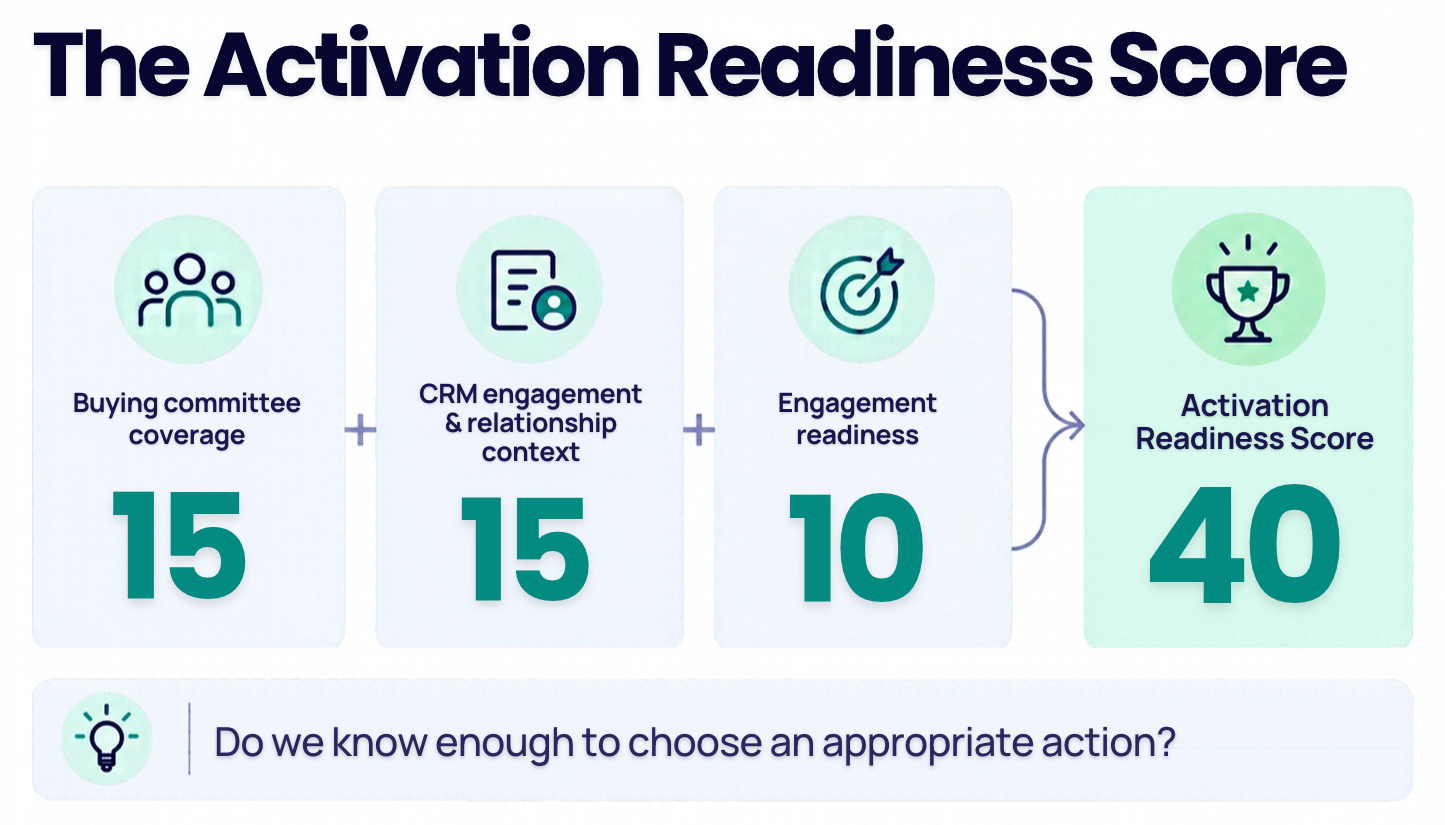
Buying committee coverage prevents reliance on one visible contact. CRM context prevents duplicated or badly timed engagement. Engagement readiness tests whether there is a relevant reason, an appropriate person and a practical route to begin a conversation.
Buying Committee Coverage: 15 Points
B2B intent usually appears at account level, while conversations happen with individuals. The person doing the most research may not control the decision. Users, technical evaluators, internal champions, budget owners and senior decision-makers may investigate different parts of the same purchase.
Assess whether:
- Relevant stakeholders have been identified.
- Their likely buying roles are understood.
- Activity or engagement extends beyond one person.
- Important gaps remain in the stakeholder map.
The aim is not to collect as many contacts as possible. Two well-understood stakeholders can provide better coverage than ten unrelated CRM records.
CRM engagement and relationship context: 15 points
Intent data should be interpreted alongside the organisation's existing relationship with the account. Useful context includes previous sales conversations, current or past opportunities, event and content engagement, account ownership, recent objections, and customer or partner relationships.
CRM activity should not automatically increase the score. Repeated unanswered emails, an old closed-lost opportunity or a recent negative interaction may reduce readiness. The purpose of CRM context is to explain what has already happened and prevent disconnected or duplicated outreach.
Engagement readiness: 10 points
The final dimension determines whether the team has enough evidence and practical clarity to take an appropriate next step. It considers whether the team has:
- A clear reason for engagement.
- An identifiable stakeholder or entry point.
- A message connected to a relevant business issue.
- Agreed account ownership and a suitable channel.
- No relationship, compliance or suppression conflict.
This score measures whether outreach can be relevant and useful. It does not measure how urgently sales wants to pursue the account.
Apply suppression rules and activation blockers first
Part 1 excludes or reviews unsuitable accounts before prioritisation. Keep that rule in Part 2. The combined score can remain visible for analysis, but it should not be used for routing or outreach unless the account passes the Part 1 suppression checks.
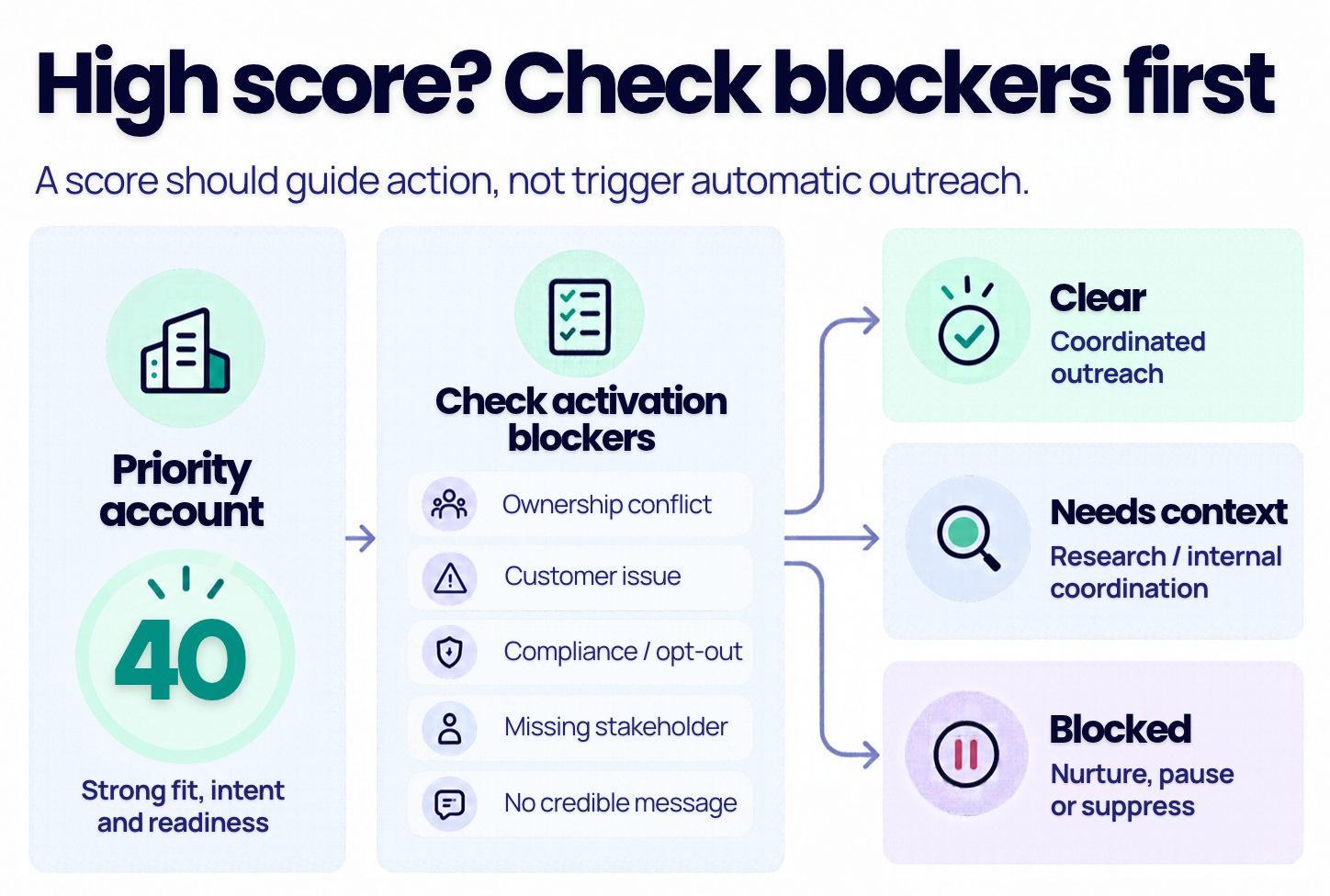
Even then, delay or change outreach when there is:
- No confirmed account owner, or another representative is already engaging the account.
- An unresolved customer or service issue.
- A recent request not to be contacted or an incomplete compliance requirement.
- No identifiable stakeholder connected to the research.
- No credible message that can be delivered without making the buyer feel monitored.
A blocker does not always disqualify the account. It may redirect the next step towards internal coordination, marketing nurture or further research instead of immediate sales contact.
Worked example: completing the account scores
Part 1 compared three accounts using the 60-point Account Opportunity Score. Adding activation readiness completes the assessment.
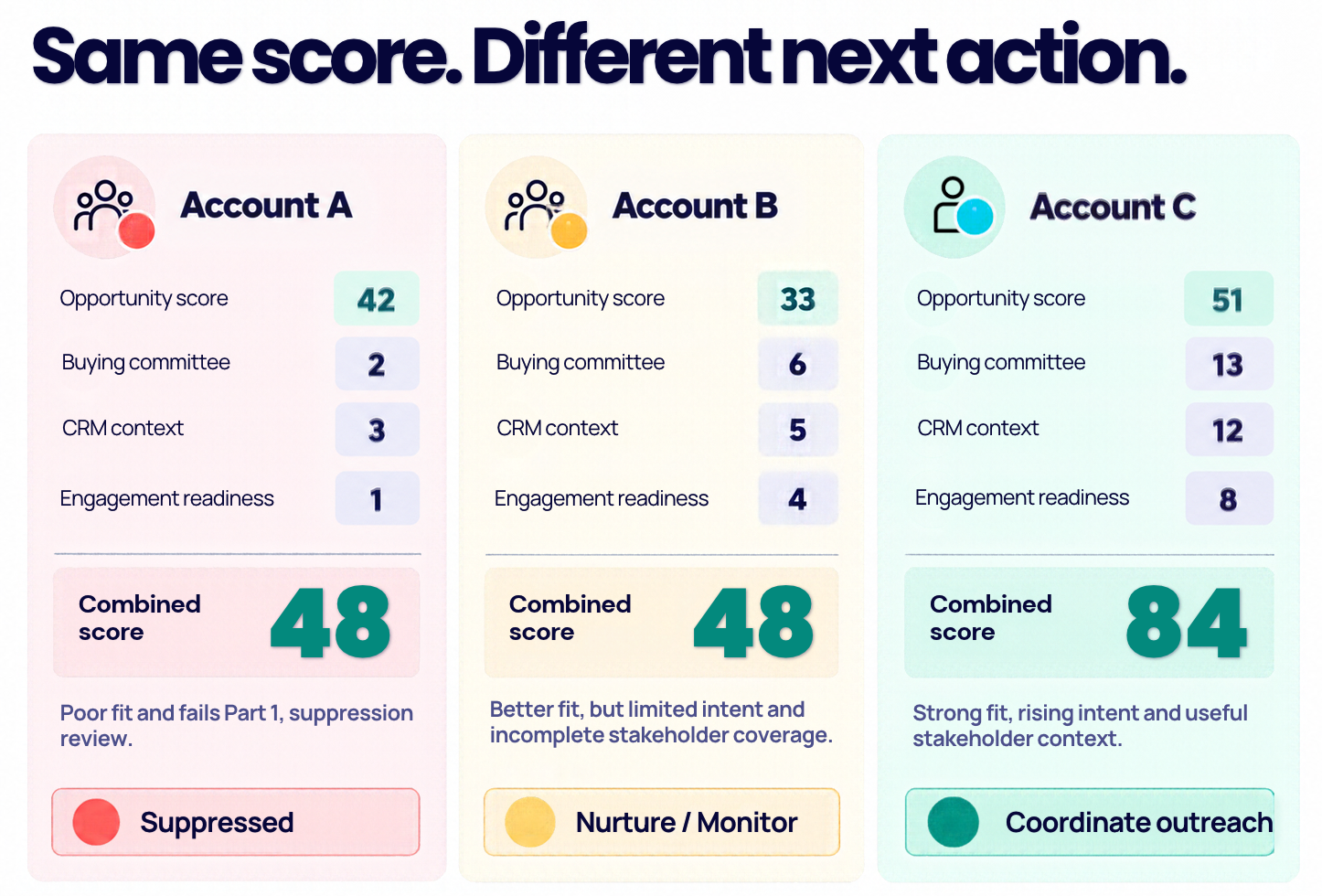
Account A generated strong activity but has poor fit and would fail the Part 1 suppression review. Its combined score therefore does not indicate action.
Account B is a stronger fit, but limited intent and incomplete stakeholder coverage indicate that nurture and monitoring are more appropriate.
Account C combines strong fit, increasing intent, buying committee coverage and useful CRM context. Its score of 84 supports coordinated sales action, subject to a final blocker check.
Accounts A and B both total 48, but they require different treatment. The components and suppression status matter more than the total alone.
How to interpret the complete 100-point score
Treat these bands as starting points. Calibrate them against sales acceptance, opportunity creation and revenue outcomes. A priority score should trigger a review and coordinated action, not an automatic generic email.
Turn intent into a relevant reason for outreach
Intent data should inform the conversation without becoming the conversation. Avoid opening with: 'We noticed that people at your company have been researching this topic.' That can feel intrusive and exposes monitoring that the buyer may not expect.
Use the signal to identify the business issue, likely stakeholder, timing and useful insight. A more appropriate opening might be: 'Many enterprise revenue teams can identify accounts showing interest but still struggle to separate research activity from genuine sales readiness. Is improving that prioritisation process relevant to your team?'
The message uses intent as internal context but focuses on the buyer's potential problem.
Match the action to the stakeholder
Different buying committee members may interpret the same issue differently. A marketing leader may care about hidden demand and campaign efficiency. A revenue operations leader may focus on scoring, CRM integration and routing. A sales leader may care about account priority, outreach relevance and pipeline conversion.
The account signal may be the same, but the action and message should reflect the stakeholder's responsibilities and the team's current relationship with that person.
Put the model into the revenue workflow
- Show the evidence. Display both scores and their contributing factors.
- Define ownership. Specify which team owns each score band and when ownership transfers.
- Attach context to alerts. Include the signals, topics, stakeholders, CRM history and recommended action.
- Set an action window. Define how quickly each band should be reviewed.
- Capture feedback. Record whether sales accepted the account, found the timing relevant and created an opportunity.
The score should support a transparent process rather than become another unexplained data-provider label.
How Sales Nitro™ supports the process
Sales Nitro™ helps B2B revenue teams identify target accounts showing meaningful movement, connect behavioural signals with account and buying committee context, and translate those signals into clearer engagement priorities.
The Intent to Action framework adds decision logic around that intelligence. It does not assume that Sales Nitro™ automatically calculates the 100-point score.
Measure decision quality
Evaluate the model through revenue outcomes, including:
- Sales acceptance of prioritised accounts.
- Time from meaningful intent to appropriate action.
- Conversion to qualified opportunity and progression by score band.
- False-positive rates and pipeline generated by priority band.
If highly scored accounts repeatedly fail to progress, review the weights, signal definitions and thresholds.
From intent signals to coordinated action
The 60-point Account Opportunity Score determines whether an account deserves attention. The 40-point Activation Readiness Score determines whether the team knows enough to act. Together, they help revenue teams avoid premature outreach while responding quickly when fit, intent, and stakeholder context ßßalign.
Use the scoring toolkit from Part 1 to capture the Opportunity Score. Apply the Activation Readiness Score during account review, routing and outreach planning so the next action reflects stakeholder, CRM and relationship context.
Want to put the framework into practice across your account, intent and CRM data? Talk to Think ABM about using Sales Nitro to create clearer engagement priorities.
Psychological precision. Better conversations.
Frequently Asked Questions
What is activation readiness?
Activation readiness measures whether a prioritised account has enough stakeholder, CRM and engagement context to justify a defined marketing or sales action.
When should sales contact an intent active account?
Sales should normally engage when the account combines strong opportunity evidence with relevant stakeholder coverage, current relationship context and a credible reason for outreach, and no suppression rule or blocker applies.
Can the score automatically trigger outreach?
The score can trigger alerts, routing or account review. Human review should remain part of high-value account activation because a number may not capture recent conversations, relationship conflicts, compliance concerns or message relevance.
How can sales use intent data without making outreach intrusive?
Use the data to understand likely priorities, timing and stakeholder relevance. Build the message around the buyer's problem, not around the fact that their activity was observed.