

Most B2B buyers don't announce themselves the moment they enter the market.
They rarely start by filling out a form, requesting a demo, or speaking with Sales directly. More often, the process starts quietly. Someone begins researching a challenge, exploring different approaches, comparing vendors, or trying to understand whether change is necessary.
That activity may continue forweeks before the buyer becomes visible.
By the time a prospect finally raises their hand, the buying journey may already be well underway. The problem may have been defined, internal opinions may have formed, and a shortlist of possible solutions may already be taking shape.
For marketers, that creates animportant question: how do you identify demand before the buyerformally declares it?
That is where hidden demand becomes valuable.
Demand usually exists before conversion
Traditional demand generation often treats conversion as the beginning of an opportunity. A form fill, event registration or demo request becomes the moment a buyer is recognised as active.
In reality, those actions usuallycome much later.
Before that point, buyers are often researching anonymously. They may be consuming educational content, reading analyst commentary, comparing technologies or returning repeatedly to a particular topic.
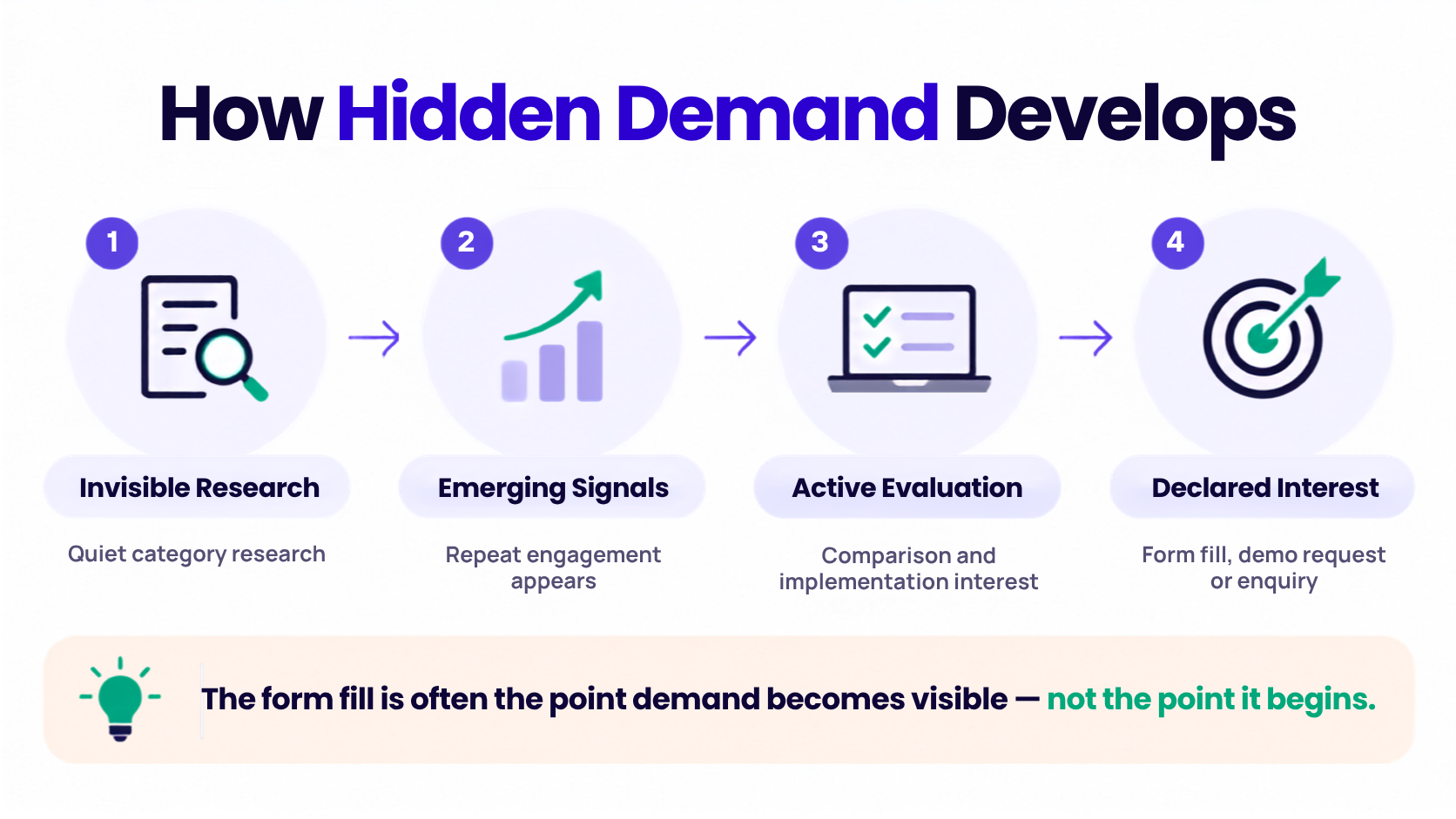
A single interaction may not mean much. What matters is whether a pattern starts to emerge, for example:
- research becoming more frequent
- interest moving from broad topics to more specific ones
- repeat engagement with related content
- activity appearing across multiple stakeholders
- growing interest inimplementation, comparison or commercial content
An account might start with broad research on cloud security, then gradually move toward compliance, implementation, and vendor comparisons.
From a conventional demand-generation perspective, the final interaction may look like the beginning of the opportunity.
In reality, the buying journeystarted much earlier.
That difference matters because the early research phase is often when buyers are still deciding what matters,what risks to prioritise and what criteria should shape the evaluation.
This is the period in which hidden demand is easiest to influence.
Why early visibility matters
The value of identifying hidden demand is not simply that Marketing gets to an account earlier. It is that early visibility creates more opportunity to influence how the problem is understood before the buying process becomes fixed.
During the research phase, buyersare still shaping their thinking. They may be influenced by:
- vendor content
- analyst commentary
- peer recommendations
- industry research
- customer examples
- educational resources
If a competitor is already present during that period, they may help define the conversation before another vendor even knows an opportunity exists. By the time a prospect fills in a form, the buying committee may already have a preferred approach in mind, even if it has not yet chosen a supplier.
That does not mean every early signal should trigger direct sales outreach.
In many cases, that would be counterproductive.
A buyer who is still trying to understand the problem may have little interest in speaking to a sales person, and premature outreach can make a brand feel intrusive rather than helpful.
A better approach is to use early signals to judge how the account should be supported.
Early on, that may mean educational insight or benchmark data. As research becomes more specific, customer proof, implementation guidance or product comparison content may become more useful..
The advantage isn't simply knowing about demand sooner.
It is having more time to become useful while the buying criteria are still taking shape.
Turning hidden demand into something useful
Intent data can tell you that something is happening inside an account, but the signal becomes much more valuable when it is interpreted in context.
An organisation may be researching cloud infrastructure, for example, but that alone tells you very little about what is actually driving the activity.
A technical team may be reviewing integration options. Finance may be assessing cost and commercial risk. An executive sponsor may be exploring a wider transformation programme.
All three could be part of the same opportunity, but they are unlikely to need the same information or respond to the same conversation.
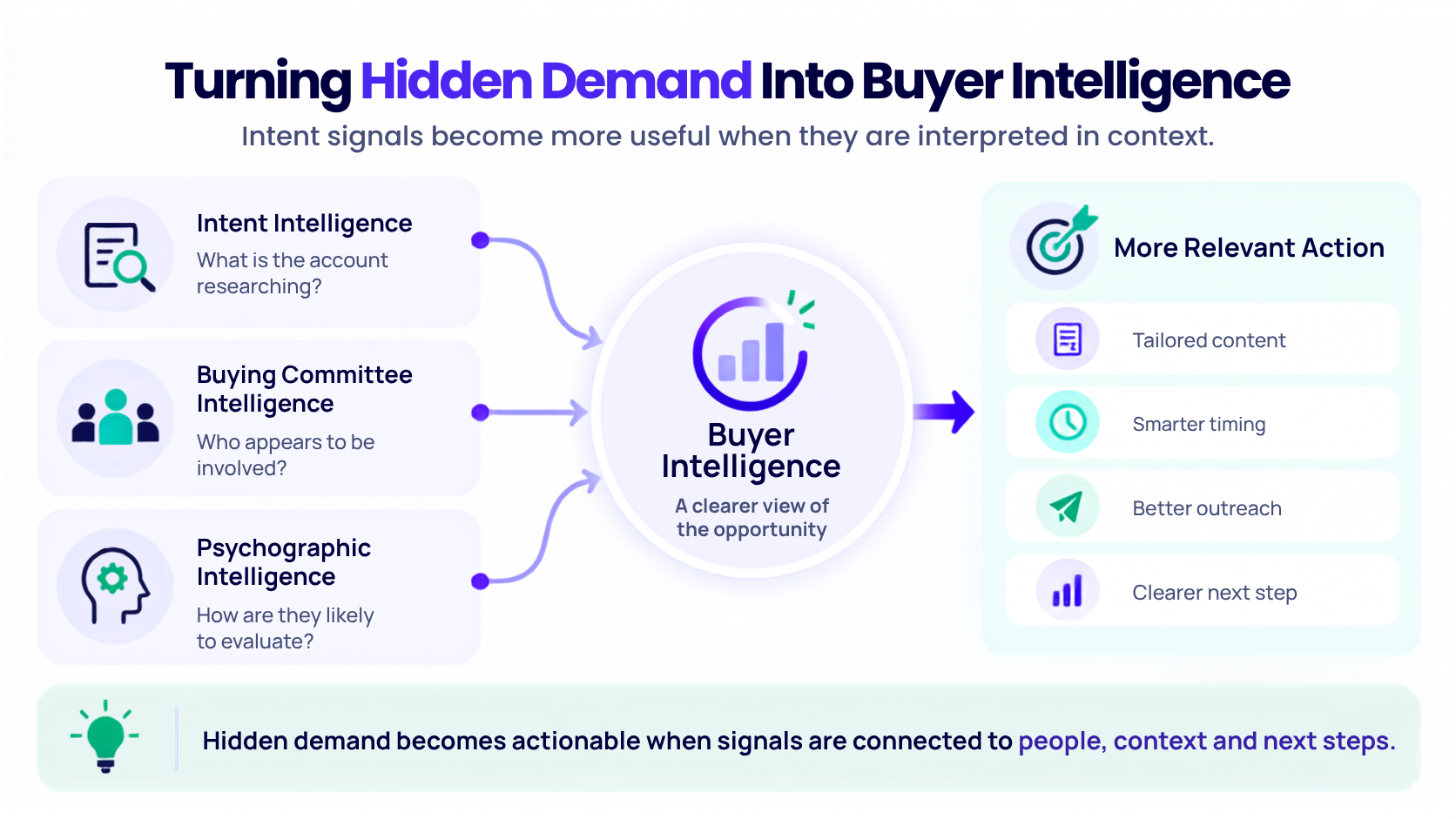
This is where Buyer Intelligence adds depth to hidden demand.
By combining intent signals with an understanding of the buying committee and the way individual stakeholders are likely to evaluate information, Marketing and Sales can move beyond simply labelling an account as “high intent”.
Instead, they can begin to see howthe opportunity is developing.
- Who appears to be involved?
- What questions are being explored?
- Which topics are attracting more attention?
- Is the account still learning about the problem, or is it starting to compare solutions?
That context changes what teams can do with the signal.
Rather than sending the same nurture sequence to every active account, Marketing can adapt content around the questions buyers are actually trying to answer. Sales can wait until the timing is more appropriate and enter the conversation with a clearer understanding of what matters to the people involved.
Hidden demand then becomes more than anonymous activity.
It becomes a useful view of the buying journey before the buyer is ready to declare it.
From demand capture to demand influence
The biggest shift is strategic.
Traditional demand generation focuses on capturing buyers once they become visible.
A hidden-demand approach focuses on recognising meaningful buying activity earlier and joining the journey before the buyer is ready to speak directly with Sales. That does not mean contacting people faster. It means understanding them earlier.
At Think ABM, SalesNitro™ helps identify and prioritise emerging buying activity, while InsightsIQ™adds psychographic context around the people behind those signals.
The objective is to understand what is changing inside an account early enough to respond with greater relevance.
Because by the time a buyer raises their hand, the decision may already be well underway.
The brands with the greatest opportunity to influence that decision are often the ones that became useful before anyone asked them to sell.
Psychological precision. Betterconversations.
Frequently Asked Questions
What is hidden demand in B2Bmarketing?
Hidden demand is buying interest that exists before a prospect becomes visiblethrough a form fill, demo request or direct sales enquiry.
How can marketers identifyhidden demand?
Look for patterns across research behaviour, repeat engagement, accountactivity and increasing interest in more specific or commercial topics.
Should Sales contact everyaccount showing intent?
No. Early-stage intent often indicates research rather than readiness.Content-led engagement is usually more appropriate until stronger buyingsignals emerge.
Why is hidden demand importantfor ABM?
It gives ABM teams more opportunity to influence buying criteria, engagerelevant stakeholders and build relevance before competitors shape theconversation.